Tuesday 16th December 2025
GCSE Computing Choices Explained: Computer Science or Creative iMedia at Stamford School
Which computing subject is right for me?
When you are picking your options for Year 9, you are presented with two choices for Computing. On the one hand, there is Computer Science and, on the other, the new and unusual Creative iMedia. You may think that everything you have studied up to this point is Computer Science, but that is a dangerous assumption to make.
Computer Science
Computer Science is the science of how computers work. It is a little bit of physics. You are using complex devices made up of electrical components after all, and the physics of how transistors are used forms part of Year 9. You will dive into logic gates, look at keyboards, and understand the inner workings of circuits.
It is a little bit of maths. You will be working with binary (0 and 1), denary (the normal 0–9 numbers you are used to) and hexadecimal (0, 1, 2, 3, 4, 5, 6, 7, 8, 9, A, B, C, D, E, F – counting in sixteens). You will find out how to convert between them, add and subtract them, and how computers use them to represent everything from colours and images to text and sounds.
And then it is a little like every other subject in that there are new facts to learn and new challenges to face. Computer components such as the CPU, GPU, RAM and other TLAs, their purpose and how they operate, network layouts and components, the layers of the internet, and programming in Python, to name but a few.
Exam-wise, Computer Science is a standard GCSE with two papers at the end, each 90 minutes long and each worth 80 marks. Paper 1 concentrates on the theory of computer science, while Paper 2 focuses on code and programming.
GCSE Computer Science leads naturally on to A level Computer Science.
Creative iMedia
On the other hand, we have Creative iMedia. This is about learning how to get computers to work for you as a tool to complete large projects. You will spend much of Year 9 learning the basics of the theory, practising with different pieces of software, and beginning to understand how we take a set of instructions from a client, the client brief, and work out exactly what we are going to make.
It is a little bit art. You need creative imagination to get the most from your coursework, and you will have to sketch out your ideas before you can start to create them. It is a little bit English, more than a little, really, as your justifications will make the difference between the lower and higher mark bands. It is also a little bit project management, as you learn industry tools and techniques to manage your time and organise your work.
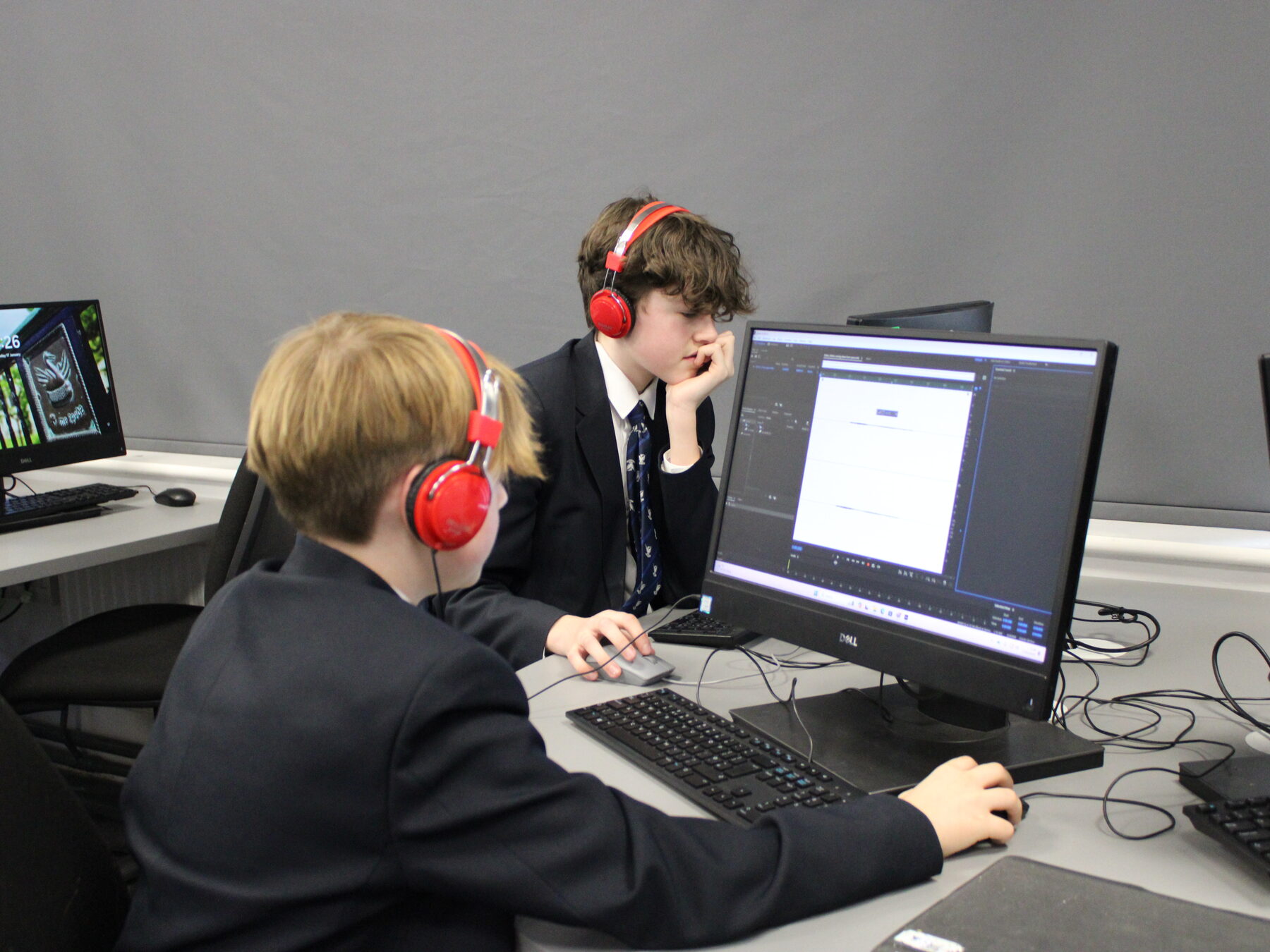
You will spend a lot of time learning new skills and new software, focusing on Photoshop for your first coursework and PowerPoint for your second, along with sound and video editing in Adobe Audition and Premiere Pro. You will also learn about the media and creative industries, the job roles available, and how everything flows from the initial idea through to the final product.
Assessment is by two pieces of coursework completed in class, one in Year 10 and one in Year 11. At the end of Year 11, there is a single 90-minute exam.
As a Cambridge National subject, Creative iMedia is graded differently from a GCSE. Instead of the usual grades 1 to 9, you will be awarded a qualification ranging from a Level 1 Pass, roughly equivalent to a grade 1, to a Level 2 Distinction*, roughly equivalent to a grade 9. The coursework-heavy nature of the course means it is actually harder to achieve a Level 2 Distinction* in a Cambridge National than it is to achieve a grade 9 at GCSE. You have to be fully committed from the very first coursework lessons in Year 10.
Progression from the Cambridge National in Creative iMedia flows smoothly into the CTEC in Digital Media at A level. Like the Cambridge National, it is graded as Pass, Merit, Distinction or Distinction*, but it still counts towards UCAS points for university applications.
Of course, you are not restricted to taking only one option. You could always take both.
Written by Teacher of Computer Science, Mr Clayton.